
More staff. Around €230,000 lower costs
The methodology Costvise translates into software. A case from practice in the social care sector.

The methodology Costvise translates into software. Shown in a case from practice in the social care sector.
Key figures at a glance
- Around €230,000 lower personnel costs compared with the reference period
- 100% of the accumulated overtime backlog cleared
- Around five months of analysis
- Targeted increase of core staffing in nursing assistance
- A mid sized care facility in Austria
Starting situation
An overtime backlog that could no longer be cleared.
An Austrian care facility was caught in a familiar spiral: overtime accumulated over months in nursing assistance (PA), planned holidays that could not be taken, and employees unable to use their time off in lieu because the staff simply were not there.
In care facilities, personnel costs account for around 70 to 80% of total expenditure. Yet the information needed to manage them sat scattered across spreadsheets, the time tracking system, payroll and monthly reports.
Every peak in workload was absorbed by the core team. Missing capacity made it harder to reduce existing time credits while increasing the pressure on the remaining staff. The overtime backlog kept growing.
The core question: how does the facility escape this spiral without exceeding its personnel cost budget?
Analysis and measure
The methodology behind Costvise, applied manually.
Drawing on her research and many years of practice in the sector, co-founder Liria Binaku developed a methodical approach that makes the actual staffing situation and its economic effects visible in three steps.
1. Data consolidation
Staffing plan, actual staffing, open overtime and time in lieu balances, planned holidays and personnel costs were brought together per care unit in a single view. For the first time this produced an overall picture from information that had previously been viewed separately.
2. Diagnosis with domain logic
The analysis showed that the problem was not current demand but the accumulated backlog. Every day without reduction generated further follow-up costs through overtime premiums and growing balance sheet provisions. The key lever was therefore not to keep staffing as lean as possible, but to consider the effects of different staffing decisions as a whole.
3. Scenario calculation
Based on the consolidated data, the effect of a targeted increase in core staffing in nursing assistance was calculated. The additional full-time positions were not meant simply to add capacity. They were deployed specifically to clear the backlog of overtime, holidays and time in lieu, and to stabilise the baseline staffing.
The counterintuitive lever
Why additional full-time positions were able to lower personnel costs.
At first glance the arithmetic seems clear: more full-time positions mean higher base salaries and therefore higher personnel costs. Viewed as an isolated cost item, the increase looks like a budget overrun. End of discussion.
Only by linking personnel, time and cost data did the second order effect become visible: what these positions no longer trigger.
Overtime premiums no longer applied.
The increased core staffing made it possible to clear the accumulated overtime completely. The backlog was reduced by 100% within the analysis period. This removed the premiums on additional hours that had previously become a fixed cost item.
Provisions for holidays and time in lieu fell.
Planned holidays and time in lieu could finally be taken. The balance sheet provisions were reduced and the core team was relieved.
Baseline staffing was stabilised.
Persistent overload typically produces a higher rate of sick leave, which in turn places an additional burden on the remaining employees. The more stable baseline staffing interrupted this spiral and absorbed peaks in workload without immediately building new time credits. There was no need to fall back on expensive agency staff.
The decisive effect lay not in the cost of the additional positions, but in the cost streams those positions influenced.
The result
More spent in the right place, less spent overall.
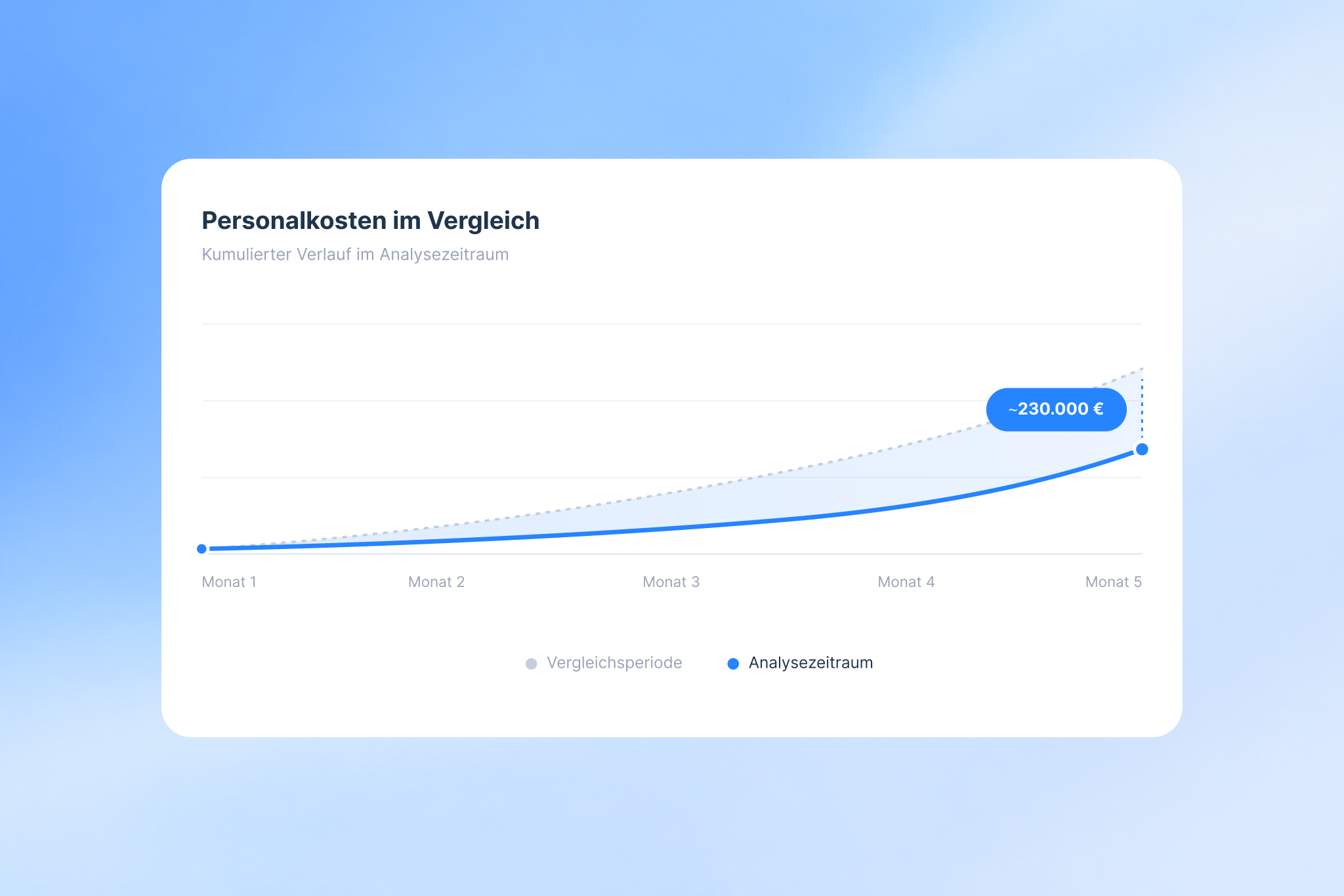
Over the period under review, the difference compared with the reference period amounted to around €230,000 in direct personnel costs. The additional cost of the increased core staffing is already included in this figure. At the same time, the accumulated overtime had been cleared completely by the end of the period.
The economic effect therefore did not come from cutting staff, but from a targeted change in the staffing structure and its effects on other cost items. A decision that looks more expensive in isolation proved economically advantageous when viewed as a whole.
Beyond the money
Effects that are hard to express in financial terms.
Less strain on the core team.
Accumulated overtime could be reduced and peaks in workload for existing employees became less frequent.
More predictability for employees.
Planned holidays and time in lieu became genuinely available.
More stable primary nursing.
More consistent staffing means more continuity in the care relationship.
Less pressure to improvise.
Duty rosters are rearranged at short notice less often and staff planning becomes more predictable.
These effects are not part of the stated figure of around €230,000 and are not counted as additional financial benefit.
From methodology to platform
What was manual analysis becomes systematically available with Costvise.
The methodology from this case forms the professional core of Costvise. What previously required manual consolidation of different data sources, spreadsheet analysis and deep domain knowledge, Costvise brings together in a shared decision logic. Personnel, time and cost data are linked so that not only individual metrics become visible, but the connections between them.
Costvise combines three levels of workforce management:
What has happened?
Transparency about staffing, costs, variances and relevant workforce indicators.
What is likely to happen?
Early recognition of developments, bottlenecks and economic effects.
What can we do?
Compare scenarios and see the effects of different staffing decisions before they are made.
This turns reporting into a basis for genuine management.
“This case showed me how much value lies in the right view of the data. That is exactly the methodology we are building into Costvise as software, so that other organisations do not have to spend weeks making the decisive connections visible themselves.”
Liria Binaku · Co-Founder & CEO
Methodology and context
The stated figure of around €230,000 refers to the balance of direct personnel costs compared with a corresponding reference period. The following were taken into account in particular:
- Core staffing including the additional positions
- Overtime premiums
- Special payments
- Employer contributions
- Changes in provisions for holidays and time in lieu
The additional cost of the increased core staffing is therefore already included in the balance. The analysis period covers around five months. The figure of 100% refers to the overtime backlog in nursing assistance that existed at the beginning of the period. The results shown relate to the case described and cannot be transferred to other facilities without taking their respective staffing structure and starting situation into account.
Conclusion
The roughly €230,000 did not arise because less was spent. They arose because more was spent in the right place.
Additional full-time positions raised the visible cost of core staffing immediately. At the same time they ended three cost streams that had been running in the background: overtime premiums, growing provisions and the follow-up costs of persistent overload.
This is precisely where reporting parts ways with management. The additional cost of an increase is visible at once, it sits in a single line. What the increase prevents appears in no single report, because it is spread across payroll, time tracking and the balance sheet. The decisive figure was available in the facility, it was simply never in one place.
The logic is not tied to one facility. Wherever overtime and untaken holidays build up over months, the same spiral develops. A report can show that personnel costs have risen or fallen. For a good decision that is not enough. What matters is understanding why a metric changes, which development is emerging and which options are available.
That is where Costvise comes in. Existing data becomes a basis for forward looking staffing decisions.


.png)





3100 St. Pölten
